
Photosynthesis Comic Strip
Photosynthesis Comic Strip: A Creative Science Learning Guide
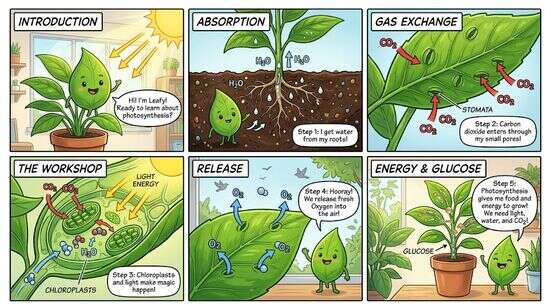
Table of Contents
Introduction
Learning biology does not have to feel complicated or boring. A photosynthesis comic strip transforms one of the most important scientific processes into an engaging visual story that students can easily understand and remember. Instead of memorizing long definitions, learners follow colorful characters, exciting conversations, and step-by-step illustrations that explain how plants create their own food.
Whether you are a teacher designing classroom activities, a student preparing a science project, or a parent helping with homework, creating a photosynthesis comic strip is an enjoyable and effective learning method. Comics simplify difficult concepts by combining pictures with short conversations, making scientific information much easier to understand.
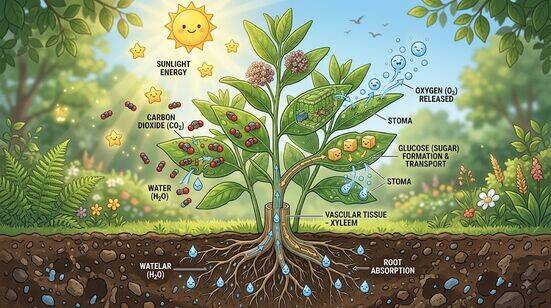
Photosynthesis is the remarkable process through which green plants use sunlight, water, and carbon dioxide to produce glucose while releasing oxygen into the atmosphere. Since this concept involves several biological steps, many learners struggle to visualize how everything happens inside a leaf. A well-designed comic strip removes that confusion by presenting each stage as part of a fun story.
Educational research consistently shows that visual learning improves memory retention and increases student engagement. Comics encourage creativity while helping learners connect scientific vocabulary with real-life situations. Instead of reading lengthy textbook explanations, students experience the process through characters representing the sun, leaves, water droplets, chloroplasts, and carbon dioxide molecules.
This complete guide explains everything you need to know about creating an outstanding photosynthesis comic strip. You will discover creative story ideas, classroom activities, project tips, character examples, educational benefits, common mistakes to avoid, and professional design techniques suitable for elementary, middle school, high school, and homeschooling environments.
By the end of this guide, you will have all the knowledge needed to create an informative, visually appealing, and educational comic strip that makes photosynthesis enjoyable for learners of every age.
Why This Guide Matters
Many students find photosynthesis difficult because they cannot see the process happening inside a plant. A photosynthesis comic strip solves this problem by turning scientific facts into an easy-to-follow visual journey.
Instead of memorizing:
- Carbon Dioxide
- Water
- Sunlight
- Chlorophyll
- Glucose
- Oxygen
Students watch these elements become story characters with individual roles. This storytelling approach encourages critical thinking, boosts classroom participation, and improves long-term understanding.
Teachers across the United States increasingly use visual learning strategies because they make complex science concepts easier to teach. Comics combine reading, writing, illustration, and biology into one engaging educational activity that supports different learning styles.
Whether your goal is improving science grades, completing a classroom assignment, or simply making biology more enjoyable, creating a photosynthesis comic strip is one of the most effective educational techniques available today.
What Is a Photosynthesis Comic Strip?
A photosynthesis comic strip is a creative educational activity that explains the process of photosynthesis through illustrations, characters, speech bubbles, and short conversations. Instead of reading long scientific paragraphs, students follow a visual story that shows how plants use sunlight, water, and carbon dioxide to make glucose and release oxygen.
Teachers often use a photosynthesis comic strip because it combines science with creativity. Students not only learn important biological concepts but also improve their reading, storytelling, drawing, and communication skills.
Unlike traditional worksheets, comic strips encourage active learning. Every panel represents one stage of photosynthesis, making it much easier to remember the sequence of events.
A typical comic strip includes:
- A cheerful sun providing light energy
- A green leaf acting as the main character
- Water traveling from the roots
- Carbon dioxide entering through leaf pores
- Chloroplasts producing food
- Oxygen leaving the leaf to support life on Earth
This storytelling approach turns a complex biological process into an enjoyable learning experience for students of all ages.
Why a Photosynthesis Comic Strip Is an Effective Learning Tool
Science becomes easier to understand when students can visualize each step. A photosynthesis comic strip helps learners connect scientific vocabulary with memorable illustrations and conversations.
Some of the biggest educational benefits include:
Improves Memory Retention
Visual storytelling helps students remember information longer than reading plain text alone. Each comic panel creates a mental image that reinforces learning.
Encourages Creativity
Students design characters, choose colors, and write dialogue, making science both educational and entertaining.
Simplifies Complex Biology
Photosynthesis involves several scientific terms that can feel overwhelming. Comics break the process into simple, manageable steps.
Supports Different Learning Styles
Whether a student learns best by reading, seeing, or creating, a comic strip offers multiple ways to absorb information.
Makes Classroom Activities More Interactive
Teachers can assign comic projects individually or in groups, encouraging teamwork and classroom participation.Understanding Photosynthesis Before Creating Your Comic
Before designing a photosynthesis comic strip, students should understand what photosynthesis actually is.
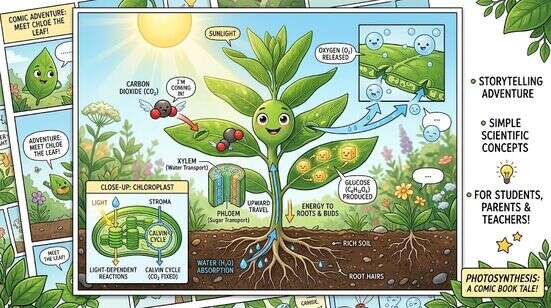
Photosynthesis is the natural process that allows green plants to manufacture their own food using sunlight.
Plants require four main ingredients:
- Sunlight
- Water
- Carbon dioxide
- Chlorophyll
These ingredients work together to produce:
- Glucose (plant food)
- Oxygen (released into the atmosphere)
Simply put, photosynthesis allows plants to survive while providing the oxygen humans and animals need to breathe.
This is why photosynthesis is considered one of the most important biological processes on Earth.
How Photosynthesis Works Step by Step
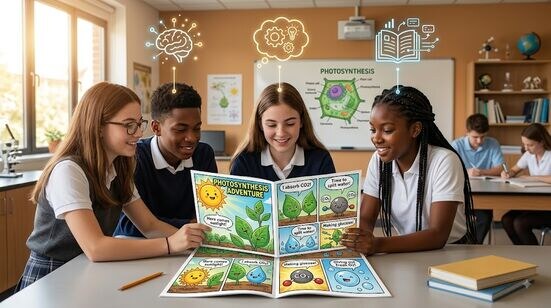
Understanding each stage makes creating a photosynthesis comic strip much easier.
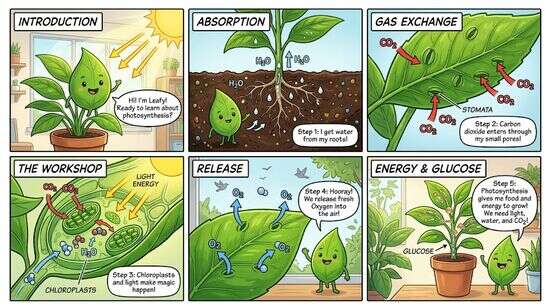
Step 1: Sunlight Reaches the Plant
The story begins with the sun shining brightly.
Sunlight provides the energy needed for photosynthesis.
Without sunlight, plants cannot produce food.
Comic idea:
Sun: “Good morning! I’m bringing today’s energy!”

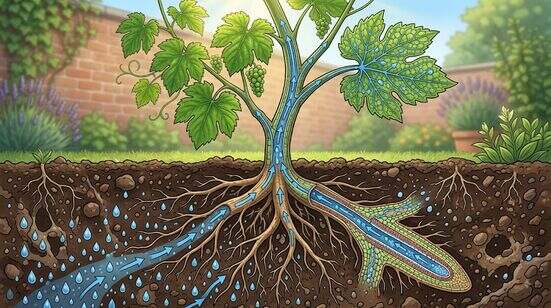
Step 2: Roots Absorb Water
The plant’s roots collect water from the soil.
The water travels upward through the stem until it reaches the leaves.
Comic idea:
Water Drop: “I’m traveling from the roots to help make plant food!”
Step 3: Leaves Collect Carbon Dioxide
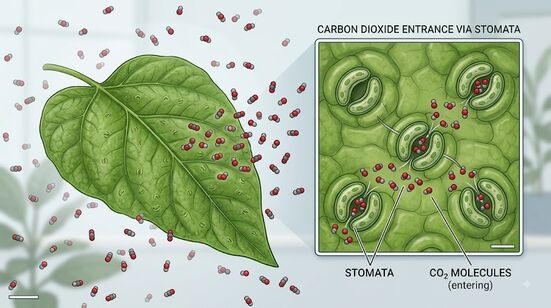
Tiny openings called stomata allow carbon dioxide from the air to enter the leaves.
Comic idea:
Carbon Dioxide: “I’m here to help build delicious glucose!”
Step 4: Chloroplasts Begin Working
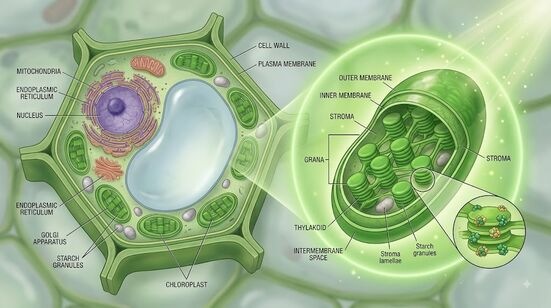
Inside each leaf are chloroplasts containing chlorophyll.
Chlorophyll captures sunlight and uses its energy to combine water and carbon dioxide.
Comic idea:
Chlorophyll: “Let’s turn sunlight into energy!”
Step 5: Glucose Is Produced
The plant creates glucose, which serves as its food.
Glucose provides energy for growth, flowering, fruit production, and survival.
Comic idea:
Plant: “Now I have food to grow strong!”
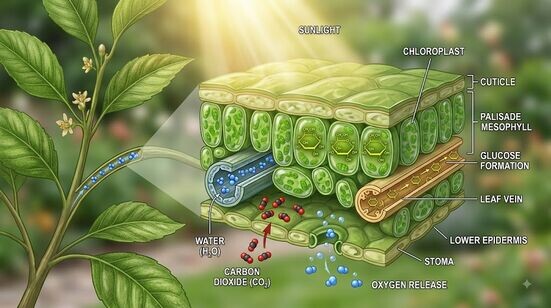
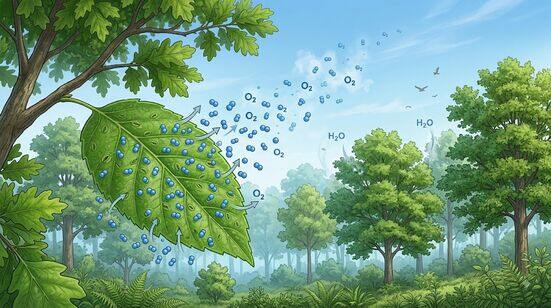
Step 6: Oxygen Is Released
As glucose is produced, oxygen is released into the atmosphere.
Humans and animals depend on this oxygen for breathing.
Comic idea:
Oxygen: “Time for me to help the world breathe!”
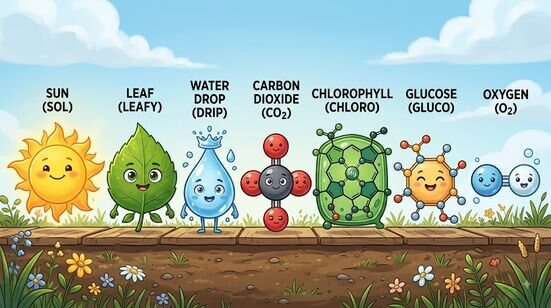
Meet the Comic Strip Characters
A fun photosynthesis comic strip becomes even more engaging when every scientific element is represented as a friendly character.
Sunny the Sun ☀️
Role:
Provides energy for photosynthesis.
Personality:
Energetic, cheerful, encouraging.
Dialogue:
“I’ll give every leaf enough energy today!”
Leafy the Leaf 🍃
Role:
Main character.
Personality:
Kind, hardworking, curious.
Dialogue:
“I can make my own food with a little help!”
Wally the Water Drop 💧
Role:
Travels from roots to leaves.
Personality:
Friendly and adventurous.
Dialogue:
“My journey begins underground!”
Coco the Carbon Dioxide Bubble 🌫️
Role:
Supplies carbon needed to make glucose.
Dialogue:
“I’m small, but I’m extremely important!”Chloe the Chlorophyll 🌿
Role:
Captures sunlight.
Dialogue:
“Watch me transform light into useful energy!”
Gigi the Glucose 🍬
Role:
Plant food.
Dialogue:
“I’m the energy every plant needs!”
Ollie the Oxygen 🌬️
Role:
Leaves the plant to support life.
Dialogue:
“Humans and animals are waiting for me!”
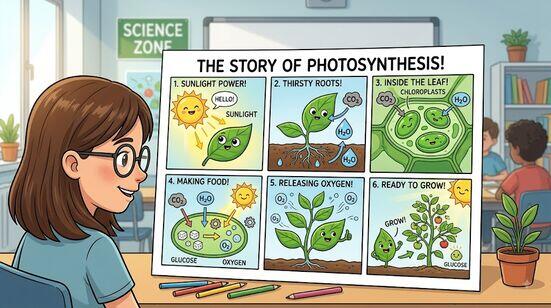
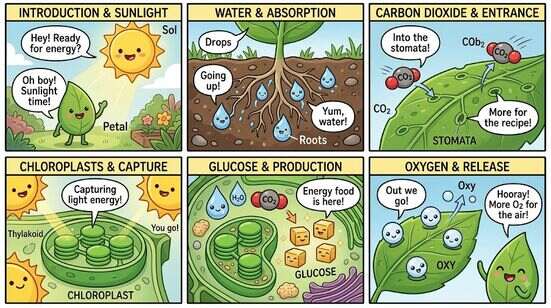
Sample Photosynthesis Comic Strip Story (Panels 1–6)
Students can use this storyboard as inspiration for their own photosynthesis comic strip project.
Panel 1
Sunny smiles from the sky.
Sunny: “Rise and shine! Time to help plants grow!”
Panel 2
Leafy waves happily.
Leafy: “I’m ready to make today’s food!”
Panel 3
Wally travels through the roots.
Wally: “Coming up from the soil!”
Panel 4
Coco enters through the stomata.
Coco: “I just arrived from the air!”
Panel 5
Chloe absorbs sunlight.
Chloe: “Let’s start the photosynthesis process!”
Panel 6
Leafy smiles while Ollie floats into the air.
Leafy: “Food is ready!”
Ollie: “I’m off to help everyone breathe!”
Why This Story Works
This simple storyline keeps scientific facts accurate while making the learning process enjoyable. Students remember characters and conversations more easily than isolated definitions, which improves both understanding and long-term retention. Teachers can also encourage students to customize characters or add additional panels to reinforce key concepts.15 Creative Photosynthesis Comic Strip Ideas
Designing a photosynthesis comic strip becomes much easier when you have creative story ideas. Whether you are completing a classroom assignment, preparing a science fair project, or teaching biology, these ideas can inspire engaging comics that are both educational and fun.
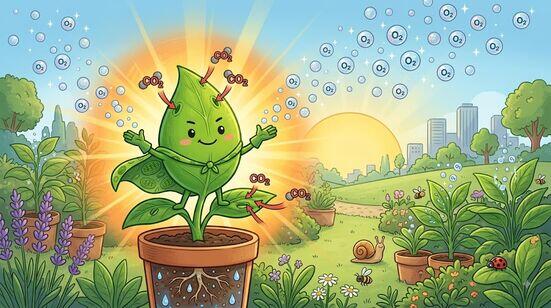
1. The Superhero Leaf
Imagine a green leaf as a superhero protecting Earth. Every day, it uses sunlight to create food and releases oxygen to help people and animals survive.
Story Idea:
The leaf saves the planet by making fresh oxygen while fighting pollution.
2. The Sun’s Daily Mission
Create a comic where the sun wakes up every morning to deliver energy to plants around the world.
Possible dialogue:
Sun: “Every sunrise is another chance to power photosynthesis!”
3. Water’s Amazing Adventure
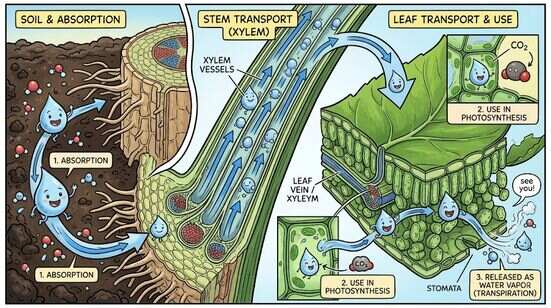
Follow a tiny water droplet traveling through the soil, entering plant roots, moving up the stem, and finally reaching the leaves.
This adventure-style photosynthesis comic strip keeps younger students interested from beginning to end.
4. Carbon Dioxide Wants to Help
Instead of making carbon dioxide the villain, turn it into a helpful character searching for plants that need it.
Dialogue example:
CO₂: “Without me, plants couldn’t make glucose!”
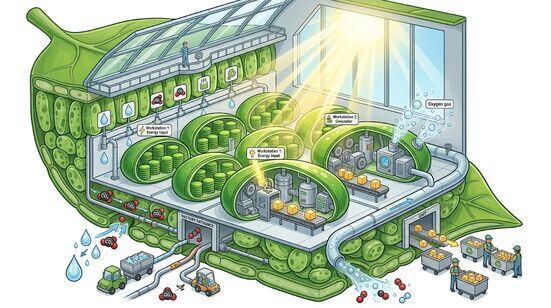
5. Inside the Leaf Factory
Imagine the inside of a leaf as a busy food factory where chloroplasts work together like employees.
Characters include:
- Factory Manager (Leaf)
- Energy Worker (Sunlight)
- Delivery Driver (Water)
- Air Supply (Carbon Dioxide)
- Product Manager (Glucose)
- Shipping Team (Oxygen)
6. Detective Chlorophyll
Turn chlorophyll into a detective solving the mystery of how plants make food.
Each comic panel reveals another clue until students discover the complete photosynthesis process.
7. The Plant Restaurant
Imagine a restaurant where ingredients arrive one by one.
Recipe:
- Sunlight
- Water
- Carbon Dioxide
Final Meal:
Glucose
Bonus Gift:
Oxygen for Earth.
8. A Day in the Life of a Tree
Follow one tree from sunrise until sunset.
Students observe how photosynthesis supports:
- Growth
- Flowers
- Fruits
- Shade
- Wildlife
9. The Chloroplast Power Station
Design chloroplasts as a giant renewable energy station producing clean energy for plants.
This idea helps explain why chloroplasts are often called the “powerhouses” of photosynthesis.
10. Tiny Plant Heroes
Every plant cell becomes a superhero working together to keep nature healthy.
Each hero has a special responsibility during photosynthesis.
11. Nature’s Recycling Team
Show how plants recycle carbon dioxide into oxygen.
This comic teaches environmental responsibility while explaining biological science.
12. Oxygen’s Journey Around the World
After leaving the leaf, oxygen travels through forests, cities, schools, and homes helping people breathe.
Students quickly understand why plants are essential for life.
13. A Garden Full of Talking Plants
Every plant explains how it performs photosynthesis differently while sharing the same basic process.
Perfect for elementary classrooms.
14. The Science School
Characters attend “Photosynthesis Academy.”
Teachers include:
- Professor Sunlight
- Professor Chlorophyll
- Professor Water
- Professor Carbon Dioxide
Graduation Reward:
Making glucose successfully.
15. Save the Forest
The comic focuses on protecting forests because healthy plants produce oxygen and support ecosystems.
Students learn both biology and environmental conservation in one engaging story.
Photosynthesis Comic Strip Ideas for Elementary School
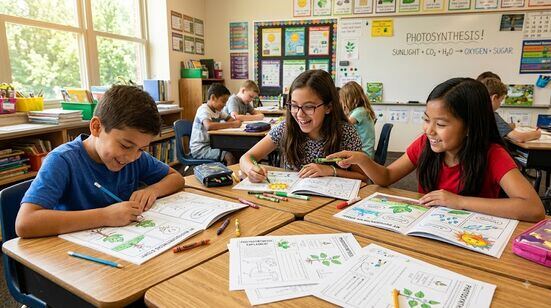
Elementary students learn best through simple language, colorful illustrations, and fun characters. A photosynthesis comic strip for younger learners should focus on basic concepts rather than complex scientific terminology.
Recommended Features
- Bright colors
- Large speech bubbles
- Happy plant characters
- Short conversations
- Four to six comic panels
- Easy vocabulary
Example Dialogue
Sun: “Hello, little plant!”
Plant: “Thanks for the sunshine!”
Water: “I’m bringing fresh water!”
Leaf: “Let’s make yummy plant food!”
Photosynthesis Comic Strip for Middle School Students
Middle school learners are ready for more scientific detail while still enjoying creative storytelling.
A photosynthesis comic strip at this level can introduce terms such as:
- Chloroplast
- Chlorophyll
- Stomata
- Glucose
- Oxygen
- Carbon Dioxide
Students can create comics with six to ten panels that explain the complete process step by step.Photosynthesis Comic Strip for High School Biology
High school students should combine creativity with scientific accuracy.
Their comic strips may include:
- Cell structures
- Chloroplast functions
- Energy conversion
- Environmental importance
- Plant adaptations
- Real-world biological applications
Teachers often use these projects to assess conceptual understanding instead of memorization.
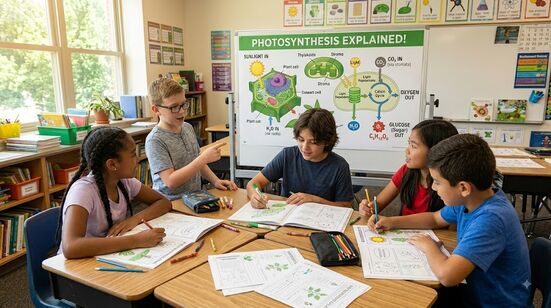
Best Classroom Activities Using a Photosynthesis Comic Strip
Teachers can use a photosynthesis comic strip in many different ways to make biology lessons more engaging.
Individual Assignment
Each student creates a unique comic explaining photosynthesis using original characters and dialogue.
Group Project
Small teams divide responsibilities:
- Writer
- Illustrator
- Researcher
- Presenter
This approach builds teamwork and communication skills.
Gallery Walk
Display completed comics around the classroom.
Students walk around, read each project, and leave positive feedback or questions.
Comic Presentation
Students explain their comic strip to classmates, strengthening both science knowledge and public speaking skills.
Comic Contest
Organize a classroom competition with awards such as:
- Most Creative Story
- Best Scientific Accuracy
- Funniest Dialogue
- Best Artwork
- Best Educational Comic
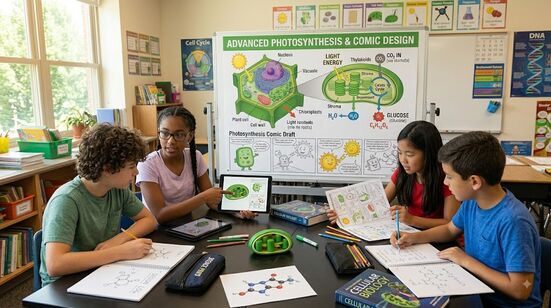
Science Fair Project Ideas
A photosynthesis comic strip can become part of an impressive science fair display.
Combine your comic with:
- A plant model
- A photosynthesis diagram
- Real leaves
- Charts showing oxygen production
- Fun biology facts
- Interactive quiz cards
This creates an educational exhibit that is both informative and visually appealing.
Design Tips for an Outstanding Comic Strip
Even a simple comic can look professional with thoughtful design. Keep these tips in mind:
Use Consistent Characters
Maintain the same appearance and personality for each character throughout the story.
Keep Speech Bubbles Short
Use concise dialogue that is easy to read and supports the illustrations.
Use Bright Colors
Green, yellow, blue, and light brown create a natural and inviting look.
Number the Panels
A clear sequence helps readers follow the story without confusion.
Focus on Accuracy
Creative storytelling is important, but the science should always remain correct.
End with a Positive Message
Finish the comic by reminding readers that plants help produce the oxygen needed for life on Earth.Best Digital Tools to Create a Photosynthesis Comic Strip
Today, students and teachers can design a professional photosynthesis comic strip without advanced graphic design skills. Many online platforms provide ready-made templates, comic characters, speech bubbles, and educational layouts that save time while improving creativity.
Whether you are working on a classroom assignment or preparing a science fair presentation, choosing the right tool makes the process much easier.

Canva
Canva offers beginner-friendly comic templates with drag-and-drop editing. Students can customize backgrounds, add plant illustrations, insert speech bubbles, and download their finished projects in high quality.
Best for:
- Classroom assignments
- Homeschool activities
- Printable comics
- Digital presentations
Pixton
Pixton allows students to create animated comic characters with customizable expressions and poses. Teachers often use it to encourage storytelling while explaining scientific concepts.
Best for:
- Interactive education
- Group projects
- Online learning
Storyboard That
Storyboard That provides professional comic layouts specifically designed for educational storytelling. It includes classroom-friendly templates that help organize scientific processes into clear visual sequences.
Best for:
- Biology lessons
- Science projects
- Educational storytelling
Google Slides
Many teachers prefer Google Slides because it is free, collaborative, and easy to use. Students can combine images, icons, and speech bubbles to create a simple but effective photosynthesis comic strip.
PowerPoint
Microsoft PowerPoint is another excellent option for designing printable comic pages. Shapes, icons, and illustrations can be arranged into comic panels with very little effort.
Printable Photosynthesis Comic Strip Worksheet Ideas
Teachers can turn a photosynthesis comic strip into an interactive classroom worksheet. Instead of giving students a blank page, provide a structured template that guides them through the story.
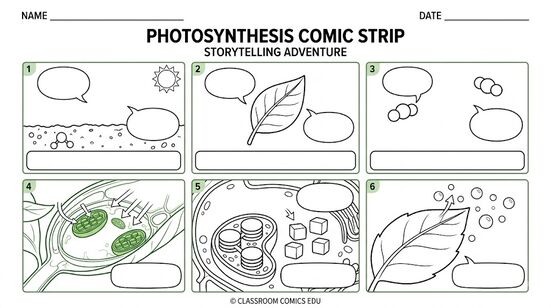
Worksheet Activity 1: Fill in the Speech Bubbles
Students receive completed illustrations but must write the dialogue for each character.
This activity strengthens:
- Scientific vocabulary
- Writing skills
- Concept understanding
Worksheet Activity 2: Arrange the Story
Cut each comic panel apart and ask students to place the events in the correct order.
This reinforces the sequence of photosynthesis.
Worksheet Activity 3: Draw the Missing Character
Provide a partially completed comic and ask students to draw one missing element, such as the Sun, Water, Carbon Dioxide, or Oxygen.
Worksheet Activity 4: Create Your Own Ending
Students invent an original final panel explaining why photosynthesis is important for humans and the environment.
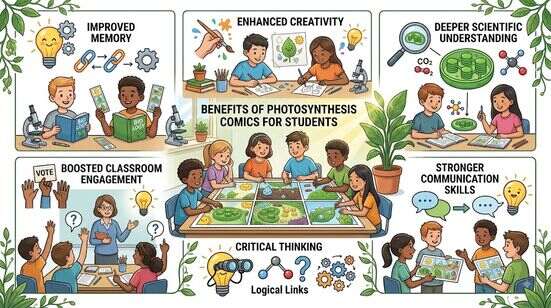
Benefits of a Photosynthesis Comic Strip for Students
Creating a photosynthesis comic strip offers much more than a fun classroom activity. It develops important academic and creative skills that support long-term learning.
Improves Critical Thinking
Students organize scientific events into a logical sequence instead of simply memorizing definitions.
Strengthens Scientific Vocabulary
Repeated use of words such as chloroplast, glucose, oxygen, and carbon dioxide increases familiarity with biological terminology.
Encourages Creative Expression
Drawing characters and writing dialogue helps students connect emotionally with scientific concepts.
Boosts Confidence
Many students who struggle with traditional worksheets perform better when they can demonstrate knowledge through creative storytelling.
Makes Learning Memorable
People naturally remember stories better than isolated facts. Comics transform photosynthesis into an engaging narrative that students can recall more easily during quizzes and exams.
Benefits for Teachers
Teachers also gain several advantages by using a photosynthesis comic strip as part of classroom instruction.
Easier Assessment
Instead of grading memorized definitions, teachers evaluate conceptual understanding.
Increased Classroom Participation
Creative projects encourage even quiet students to become involved.
Supports Multiple Learning Styles
Visual, auditory, reading, and kinesthetic learners all benefit from comic-based activities.
Reduces Classroom Boredom
Students are more motivated when biology lessons include creativity and storytelling.
Benefits for Parents
Parents can also use a photosynthesis comic strip at home to support science education.
Homework Help
Parents and children can work together to create comics while discussing plant biology.
Family Learning Activity
Comic creation becomes a fun educational project rather than a stressful homework assignment.
Encourages Curiosity
Children often begin asking questions about gardens, trees, flowers, and the environment after learning through comics.
Common Mistakes to Avoid
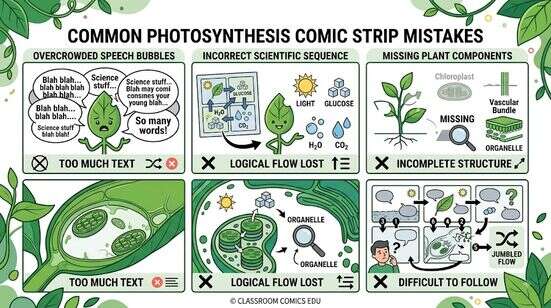
Even a creative photosynthesis comic strip can lose educational value if it contains scientific errors or poor design choices. Avoid these common mistakes to make your project accurate and engaging.
1. Using Incorrect Scientific Facts
Always verify that the comic correctly explains how photosynthesis works.
Remember:
- Plants need sunlight.
- Water comes from the roots.
- Carbon dioxide enters through the leaves.
- Glucose is produced.
- Oxygen is released.
2. Too Much Text
A comic should rely on visuals and short dialogue, not long paragraphs.
Keep each speech bubble brief and easy to understand.
3. Poor Panel Sequence
Readers should follow the story naturally from beginning to end.
Numbering panels helps prevent confusion.
4. Forgetting Labels
Important parts such as leaves, roots, chloroplasts, sunlight, and stomata should be clearly labeled where appropriate.
5. Using Dull Colors
Bright colors make educational comics more engaging and help readers identify different characters and processes.
6. Ignoring Scientific Vocabulary
Include essential biology terms, but explain them through simple dialogue so students understand their meaning.
Expert Tips for Creating an Outstanding Photosynthesis Comic Strip
If you want your photosynthesis comic strip to stand out, these expert recommendations can make a big difference.
Tell a Story
Instead of listing facts, create a beginning, middle, and ending with characters solving a problem together.
Use Friendly Characters
A smiling sun, cheerful leaf, or adventurous water droplet helps younger learners connect with the content.
Balance Creativity and Accuracy
Creative dialogue is great, but the science should always remain correct.
Add Humor
Light humor makes learning enjoyable without distracting from the lesson.
Include a Clear Lesson
End the comic by reminding readers that photosynthesis supports life by producing food for plants and oxygen for the planet.Why Photosynthesis Matters in Everyday Life
Photosynthesis is not just a classroom topic. It is one of the most important natural processes on Earth.
Without photosynthesis:
- Plants could not make food.
- Oxygen levels would decrease.
- Animals and humans would struggle to survive.
- Food chains would collapse.
- Ecosystems would become unstable.
By understanding this process through a photosynthesis comic strip, students gain a deeper appreciation for nature and the role plants play in sustaining life.
Quick Classroom Challenge
Ask students to create a six-panel photosynthesis comic strip that includes:
- The Sun
- A Green Leaf
- Water
- Carbon Dioxide
- Glucose
- Oxygen
Frequently Asked Questions (FAQs)
1. What is a photosynthesis comic strip?
A photosynthesis comic strip is a visual storytelling activity that explains how plants make their own food using sunlight, water, carbon dioxide, and chlorophyll. It combines science with creative illustrations and dialogue to make learning easier and more enjoyable.
2. Why is a photosynthesis comic strip useful for students?
It helps students understand complex biological concepts through pictures, characters, and simple conversations. Comics also improve creativity, memory retention, and scientific vocabulary.
3. Who can create a photosynthesis comic strip?
Anyone can create one, including elementary students, middle school learners, high school biology students, teachers, homeschool families, and parents supporting science education at home.
4. What should be included in a photosynthesis comic strip?
A complete photosynthesis comic strip should include:
- Sunlight
- Water
- Carbon Dioxide
- Chlorophyll
- Chloroplasts
- Glucose
- Oxygen
- A clear step-by-step storyline
5. How many panels should a photosynthesis comic strip have?
Most classroom projects use between 6 and 10 panels, but more detailed comics can include additional scenes to explain each stage of photosynthesis.
6. Can I make a digital photosynthesis comic strip?
Yes. Digital tools such as Canva, Google Slides, PowerPoint, Pixton, and Storyboard That make it easy to design professional-looking educational comics.
7. Is a photosynthesis comic strip suitable for science fairs?
Absolutely. A comic strip can become an engaging part of a science fair display, especially when combined with diagrams, plant models, or interactive learning activities.
8. How can teachers use a photosynthesis comic strip in the classroom?
Teachers can use comics for group activities, homework assignments, classroom presentations, gallery walks, science projects, quizzes, and creative assessments.
9. What are the biggest mistakes to avoid?
Common mistakes include using incorrect scientific information, overcrowding speech bubbles with text, skipping important steps, and creating confusing panel sequences.
10. Why is photosynthesis important?
Photosynthesis allows plants to produce glucose for growth while releasing oxygen into the atmosphere. This process supports ecosystems, food chains, and nearly all life on Earth.
Final Thoughts
A photosynthesis comic strip is much more than a fun classroom project. It transforms an essential biological process into an engaging visual story that students can easily understand and remember. By combining illustrations, dialogue, and scientific accuracy, comic strips encourage active learning while making biology less intimidating.
Whether you are a teacher planning creative classroom activities, a student preparing a science assignment, or a parent looking for interactive educational resources, a photosynthesis comic strip offers an effective way to explain one of nature’s most important processes.
Remember that the best comics are both educational and entertaining. Keep the science accurate, use colorful characters, write simple dialogue, and present the events in a logical sequence. A well-designed comic not only improves understanding but also inspires curiosity about plants, ecosystems, and the natural world.
As you begin creating your own comic strip, focus on telling a meaningful story that shows how sunlight, water, carbon dioxide, and chlorophyll work together to produce glucose and oxygen. With creativity and scientific accuracy, your project can become a memorable learning experience that leaves a lasting impression on readers of all ages.
Key Takeaways
Scientific accuracy should always be balanced with creativity.
A photosynthesis comic strip makes biology easier to understand through storytelling.
Visual learning improves memory and classroom engagement.
Include the correct sequence: sunlight, water, carbon dioxide, chlorophyll, glucose, and oxygen.
Keep speech bubbles short and easy to read.
Use bright colors and friendly characters to attract younger learners.
Digital and hand-drawn comics are both effective learning tools.
Comic strips work well for classroom activities, homework, and science fairs.